
The shape of the problem
An interior design practice has a data profile that almost nothing else in the SME world shares.
- The files are enormous. A single render is hundreds of megabytes. A project's CAD, models, textures, site photography and video walkthroughs run to tens of gigabytes before anything is delivered.
- Nothing is ever deleted. Not from disorganisation — from correct instinct. A client returns after four years wanting the same finish in a second property, and the studio that still has the file wins the job.
- Almost nothing is read after handover. The archive is enormous and cold. It is insurance, not working material.
- Growth is per project, not per person. Headcount is flat; storage is not.
That last point is the whole argument. Hosted collaboration suites price per user per month with a storage allowance attached. The studio's cost driver is data, and the pricing model's cost driver is people. The two diverge, permanently, in one direction.
The visible symptom is familiar: an invoice that climbs every year without anyone deciding it should, someone deleting old projects to stay under a quota, and — the expensive one — a partner keeping "the real archive" on external drives in a cupboard because the cloud got too expensive to be the source of truth.
The arithmetic
We do this calculation before recommending anything, and we have talked clients out of it.
Hosted: seats × monthly fee × 12, plus the extra storage tiers as they arrive, forever, with no residual value. Rising with headcount and with data.
On-premise: a capital cost for the server and disks, a replacement cycle of four to five years, power, and a support arrangement. Adding four terabytes is the price of two drives, not a new subscription tier.
Three things decide where the crossover lands, and none of them is the sticker price:
- Storage growth per year versus headcount growth per year. If they move together, stay hosted.
- Whether the offsite backup is honestly costed. A private cloud without an offsite replica is cheaper and is not the same product. Cost the replica.
- Whether somebody competent is responsible for it. Unmanaged on-premise storage is not cheaper. It is deferred.
For a studio in the range we usually see — around a dozen people, adding a few terabytes a year — the crossover falls in year two or three, and everything after that is a widening gap.
Why Nextcloud specifically
Four reasons, in order of how much they matter to the people using it.
- It behaves like the thing they already use. Desktop sync clients on Windows and macOS, a mobile app for site photographs, and a web interface. Designers keep working in Explorer or Finder. Migrations fail when they demand a new habit, and this one does not.
- Sharing does not require the recipient to sign up. A link with an expiry and an optional password, from a domain with the studio's name in it. Client-facing sharing is the daily use, and it is where consumer-grade tools quietly leak files that never expire.
- Selective sync is essential at this scale. Nobody's laptop can hold the archive. Virtual files — visible, on demand, downloaded when opened — are the difference between usable and unusable.
- It is open source and self-hosted. No per-seat licence, no vendor deciding your storage tier, and no cross-border transfer to justify under PDPA. If we disappear tomorrow, the studio has a standard Nextcloud instance any competent engineer can take over — which is a question worth asking any supplier before signing.
What we actually build
Deliberately dull, because storage should be:
- A server sized for the next four years, with redundant disks, in a room that is ventilated, lockable and not the one that floods.
- Nextcloud with the object storage or filesystem backend chosen for the access pattern — large sequential reads and writes, not many tiny files.
- An uninterruptible power supply that is tested. Malaysian power is good and is not perfect, and an unclean shutdown mid-write is how filesystems get interesting.
- Sync clients deployed and configured for every workstation, with selective sync set up per person rather than left as a default nobody understands.
- A folder structure agreed before migration, because migration is the only moment anyone will ever agree to one.
- Remote access done properly — a real certificate, and a VPN or a reverse proxy that has been thought about. "Port forward 443 to the NAS" is how a studio's entire archive ends up encrypted by a stranger.
The part that is not optional
Moving storage in-house means taking back a job the cloud provider was quietly doing. Anyone who sells you on-premise storage without insisting on this is selling you a liability.
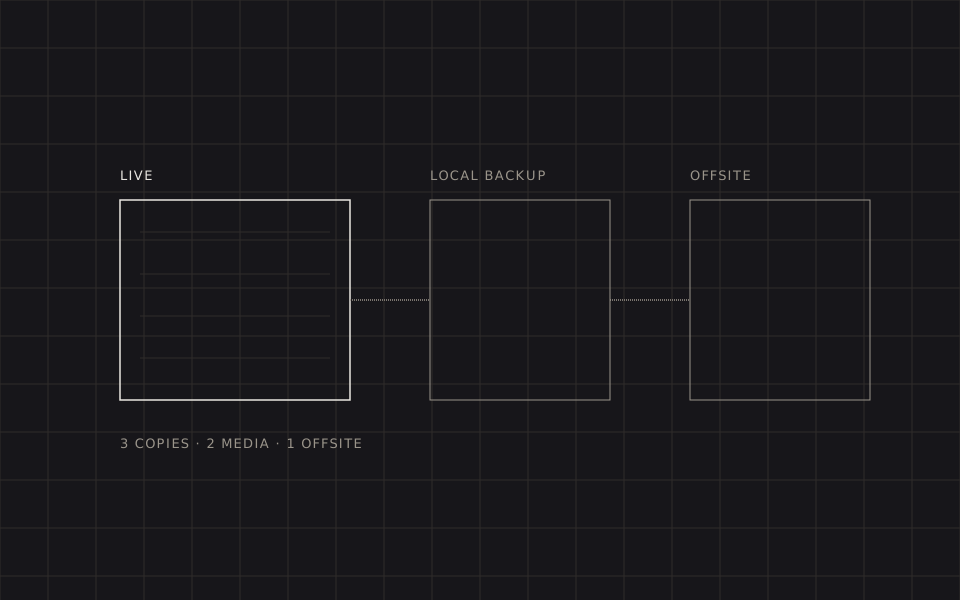
Three copies, two media, one offsite:
- The live Nextcloud instance.
- A local backup on separate hardware — fast to restore from, protects against the ordinary case of someone deleting a folder.
- An offsite replica. Encrypted, in a different building. This is the copy that survives fire, theft and ransomware, and it is the one people skip.
Plus the rule that turns a backup into a recovery capability: a restore is tested on a schedule. An untested backup is a belief. We restore a real project folder quarterly and record how long it took, because the number people actually need in a crisis is not "do we have a backup" but "how long until I can open the file".
When this is the wrong answer
Three situations where we tell people to stay on hosted storage:
- The team is genuinely distributed. If half the studio works from elsewhere, the office becomes a bottleneck and a single point of failure for people who are not in it. Cloud is correct.
- Storage is under about two terabytes and stable. The crossover has not happened and may not. Hosted storage at that scale is excellent value.
- Nobody will own it. On-premise infrastructure needs a responsible party — internal or contracted. Without one it works beautifully for eighteen months and then fails on the day it matters, with nobody watching. If the answer to "who is responsible" is a shrug, buy the subscription.
The version of this we run for design studios extends to the same question for AI: models on your own hardware, for the same reason — the data is large, sensitive, and better off not leaving.
Questions
Below about two terabytes and ten users, almost never — hosted storage is excellent value at small scale and you should stay on it. The crossover arrives when storage grows faster than headcount, because hosted plans price per user and design studios accumulate data per project. A twelve-person practice adding four terabytes a year crosses over in roughly the second or third year, including the hardware, the replacement cycle and our support.
Everyone in the building keeps working at full local-network speed, which is the opposite of what happens with cloud storage. Remote access is what stops. That trade-off is usually favourable for a studio whose people are mostly in one place, and unfavourable for a distributed team — which is why the answer depends on where your people sit, not on which technology is better.
Yes, and more visibly than before. A cloud provider was doing a job you were not thinking about. On-premise storage without a tested offsite backup is not a private cloud, it is a single point of failure with a nice web interface. Fire, theft and ransomware all hit the office server and the office NAS in the same event.